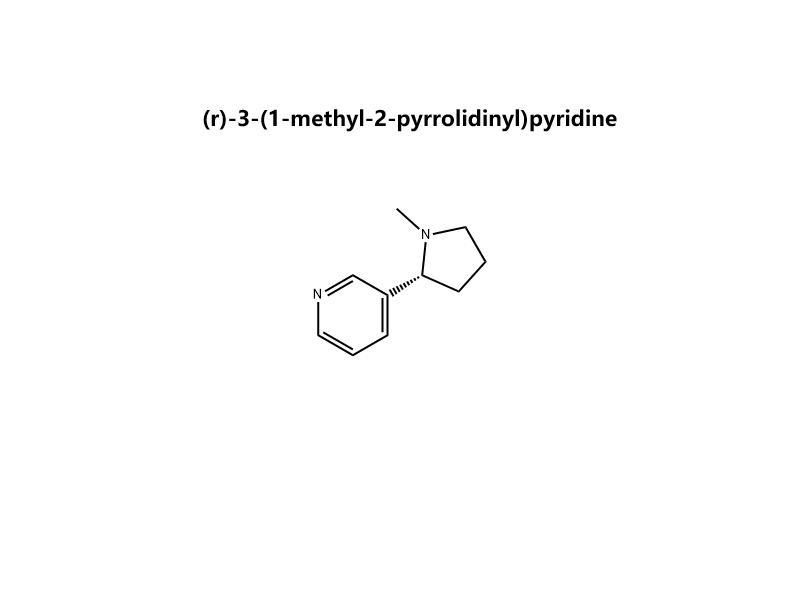
IUPAC Name: (R)-3-[(2S)-1-Methylpyrrolidin-2-yl]pyridine or (R)-1-Methyl-2-(3-pyridyl)pyrrolidine
Common Name: (R)-(−)-Nicotine; Natural Nicotine
Chemical Formula: C₁₀H₁₄N₂
Molecular Weight: 162.23 g/mol
Specific Rotation: [α]²⁰_D = approx. -166° (neat)
Structure: A pyridine (C₅H₄N) substituted at the 3-position with an (R)-configured 1-methylpyrrolidin-2-yl group.
Appearance: A clear, pale yellow to brownish, oily liquid. Darkens upon exposure to air and light.
Boiling Point: ~ 247 °C (decomposes)
Melting Point: < -80°C (Liquid at room temperature)
Density: ~1.01 g/cm³ at 20°C
Vapor Pressure: ~0.0425 mmHg at 20°C
Solubility: Miscible with water and most organic solvents (ethanol, diethyl ether, chloroform) in all proportions at temperatures below 60°C. Acts as a weak base (pKa of conjugate acid: pyridinium ~3.1, pyrrolidinium ~7.9).
Stability: Unstable in alkaline conditions; volatile with steam. Oxidizes and darkens upon prolonged exposure to air. Salts (e.g., dihydrochloride, tartrate) are more stable for storage.
Primary Pharmacology: A potent agonist of nicotinic acetylcholine receptors (nAChRs) in the central and peripheral nervous systems. This activity underlies all its physiological effects.
Effects: Acts as a stimulant at low doses, increasing heart rate, blood pressure, and release of neurotransmitters like dopamine (associated with reward and addiction) and norepinephrine. High doses act as a depolarizing blocking agent at neuromuscular junctions, leading to toxicity.
Toxicity: Highly toxic (LD50 oral, rat: ~50 mg/kg). Symptoms of acute poisoning include nausea, vomiting, tachycardia, hypertension, seizures, and respiratory failure. A known teratogen and addictive substance due to its rapid action on the brain's reward pathways.
Metabolism: Primarily metabolized in the liver by cytochrome P450 2A6 (CYP2A6) to cotinine (major metabolite) and other compounds.
Natural Biosynthesis: In the tobacco plant (Nicotiana tabacum), it is synthesized in the roots and transported to the leaves. The pathway starts from aspartic acid and glyceraldehyde-3-phosphate, proceeding through a series of steps involving putrescine, N-methylputrescine, and the pivotal intermediate, nicotine acid. The pyrrolidine ring is derived from ornithine/putrescine, and the pyridine ring from nicotinic acid (a derivative of aspartate). The final enzyme, nicotine synthase, catalyzes the coupling reaction, producing the naturally exclusive (R)-(−)-enantiomer.
Synthetic Production: Can be produced via chemical synthesis or extraction and purification from tobacco biomass or waste. Advanced synthetic routes (asymmetric synthesis, enzymatic resolution) are used to produce high-purity (R)-nicotine, avoiding the undesired (S)-enantiomer, for pharmaceutical and advanced consumer applications.
-

Pharmaceuticals
Smoking Cessation Therapies: The active ingredient in Nicotine Replacement Therapy (NRT) products (gums, patches, lozenges, inhalers) to alleviate withdrawal symptoms.
Neurological Research: A standard tool in preclinical research to study nAChR function, addiction mechanisms, and potential therapies for Parkinson's disease, cognitive decline, and ulcerative colitis (where nicotine patches have shown some effect).
-

Agrochemicals
Historically used as a potent natural insecticide (acting on insect nAChRs). Its use is now highly restricted or banned in many countries due to human toxicity.
-

E-cigarettes & Vaping Liquids
The primary addictive agent in nicotine-containing e-liquids. The shift towards "tobacco-free nicotine" (TFN) often refers to synthetically produced (R)-nicotine, marketed for its purity and consistency.
Key Advantages & Benefits
1. Unmatched Biological Specificity & Potency
Benefit: The (R)-enantiomer is the exclusive, naturally occurring form with optimal three-dimensional structure for binding to mammalian nAChR subtypes. This guarantees precise, reproducible, and biologically relevant effects in experimental systems.
Application Scenario: In advanced neuropharmacology research studying addiction pathways or cognitive function, using (R)-nicotine eliminates the confounding variable of the inactive (S)-enantiomer, ensuring that observed effects on dopamine release or neuronal firing are accurate and attributable solely to the active form.
2. Critical for Validated Research & Standardization
Benefit: Serves as the definitive reference standard for quantifying nicotine levels and studying its metabolism, toxicology, and pharmacokinetics.
Application Scenario: In forensic toxicology or pharmaceutical quality control labs, it is used to calibrate HPLC-MS/MS systems for the accurate measurement of nicotine and its metabolites (like cotinine) in biological samples, ensuring legally and medically defensible results.
3. Essential for Modern Nicotine Product Development
Benefit: Provides a consistent, high-purity active pharmaceutical ingredient (API) free from tobacco-specific impurities (TSNAs) that can arise from extraction, crucial for safety profiles.
Application Scenario: In the development of next-generation nicotine replacement therapies (NRT) or regulated tobacco-free pouches, synthetic (R)-nicotine allows for precise dosing, cleaner flavor profiles, and a stronger regulatory argument regarding product purity and characterization.
4. Enables Structure-Activity Relationship (SAR) Studies
Benefit: The pure enantiomer is the fundamental scaffold for medicinal chemists to design and test novel analogs for potential therapeutics targeting nAChRs.
Application Scenario: In drug discovery programs for neurological disorders (e.g., Parkinson's, schizophrenia, pain), researchers modify the (R)-nicotine structure to create new compounds with selective receptor subunit activity, aiming to retain cognitive benefits while eliminating addiction potential and side effects.
(R)-3-(1-Methyl-2-pyrrolidinyl)pyridine (Natural (R)-(−)-Nicotine, CAS 25162-00-9) is not a commodity chemical but a highly specialized biochemical tool and precision active ingredient. Its paramount advantage is its enantiomeric purity, which is directly linked to its biological efficacy, research validity, and regulatory acceptability. It is indispensable for cutting-edge neurological research, analytical standardization, and the development of advanced, well-characterized nicotine delivery products. For researchers and product developers, sourcing high-purity (R)-nicotine is an investment in data integrity, product consistency, and scientific credibility, distinguishing their work from studies or products reliant on less-defined racemic mixtures.
Q1: What is the difference between (R)-Nicotine and racemic nicotine?
A: The (R)-enantiomer is the naturally occurring, biologically active form with high affinity for nAChRs. Racemic nicotine (a 50/50 mix of (R) and (S) forms) is often a byproduct of non-stereoselective chemical synthesis. The (S)-enantiomer has significantly lower receptor affinity and different pharmacokinetics. For research and high-end applications, enantiomeric purity (>99% (R)) is critical for accurate biological response and consistent product performance.
Q2: What are the critical handling and storage requirements?
A: Extreme caution is required. It must be handled in a fume hood with appropriate PPE (gloves, goggles, lab coat). Store under an inert atmosphere (Argon/N₂) in a tightly sealed, dark container at 2-8°C. Purchasing and storing it as a stable salt form (e.g., dihydrochloride) is strongly recommended for improved safety and shelf life. Always consult the Safety Data Sheet (SDS).
Q3: What purity grades are available, and what should I specify for my application?
A:
Technical Grade (~95%): For non-critical industrial applications (e.g., insecticide research).
Pharmaceutical Grade (>99% chemical purity): Mandatory for NRT product development.
High Enantiomeric Purity Grade (>99.5% (R)): Essential for advanced neuropharmacology research and synthetic TFN for vaping liquids where precise receptor interaction and flavor profile are paramount. Always specify chemical purity, enantiomeric excess (e.e.), and residual solvent levels.
Q4: What is the regulatory landscape for purchasing and using this compound?
A: It is heavily regulated as a controlled substance/precursor in most jurisdictions.
USA: Regulated by the FDA and DEA. Sales are often restricted to qualified research institutions and licensed manufacturers.
EU: Subject to strict controls under chemical and consumer safety regulations (e.g., REACH, CLP). For vaping products, the Tobacco Products Directive (TPD) sets concentration limits.
Compliance: Buyers must provide end-use documentation and proof of compliance with local regulations. For commercial use in consumer products (e-cigarettes), extensive toxicological dossiers and market authorization are required.
Q5: Can it be used as a standard in analytical testing?
A: Yes, it is the primary reference standard for quantifying nicotine in tobacco, pharmaceutical, and toxicological samples via HPLC, GC-MS, or LC-MS. For this purpose, you must source a certified Reference Standard Material (CRM) from a qualified supplier, with a certificate of analysis detailing exact purity and traceability.
Q6: What are the key logistical and sourcing considerations?
A: Due to its hazard class (6.1, toxic), specialized hazardous goods (HAZMAT) shipping is mandatory, increasing cost and complexity. Lead times can be long. Source from reputable, established fine chemical or pharmaceutical ingredient suppliers with proven expertise in handling alkaloids. Be wary of discrepancies in pricing, as very low prices may indicate racemic mixtures, poor purity, or non-compliant sourcing.


 English
 English
 Español
 Português

![4-Nitrophenyl 3-(Benzo[d][1,3]dioxol-5-yl)-2-methylpropanoate](https://www.qixiolivetol.com/storage/uploads/images/202604/17/1776427287_qZy87IjHSQ.jpg)

 Contact Us


 IPv6 Network Supported |